

A research paper by Senior Associate Professor Kohei Kitazato and graduate student Sho Sakurai (at the time of the research) has been published in the scientific journal Nature Geoscience.

Information
お知らせ
A research group led by Senior Associate Professor Kohei Kitazato of our university, together with graduate student Sho Sakurai (at the time of the research), has revealed that near-Earth asteroids (Note 1) may undergo surface rejuvenation triggered by thermal shock (Note 2) that occurs when they pass through the shadows of Earth or Venus. The results of this study were published in the scientific journal Nature Geoscience on January 15, 2026.
Near-Earth asteroids lack atmospheres and therefore experience large temperature differences between day and night. As a result, their surface rocks are susceptible to crack propagation and fragmentation caused by thermal fatigue (Note 3). Thermal fatigue is considered a key factor in surface rejuvenation, as it exposes fresh material that has not been weathered by solar wind irradiation or micrometeoroid impacts. However, the mechanism by which the initial cracks that trigger thermal fatigue are generated has remained unclear.
The research group focused on the fact that near-Earth asteroids pass through the shadows of Earth and Venus. By tracing asteroid orbits back in time, the researchers investigated how frequently asteroids pass through planetary shadows. The results showed that near-Earth asteroids pass through planetary shadows more frequently than they approach planets closely enough for tidal forces to have a significant effect. Furthermore, thermophysical simulations conducted under geometric conditions corresponding to shadow passages demonstrated that planetary shadows can produce thermal shocks sufficient to generate initial cracks within rocks. These findings suggest that thermal shock caused by planetary shadows may be a primary mechanism driving surface rejuvenation on near-Earth asteroids.
This research is expected to contribute to the assessment of near-Earth asteroid impact risks and to aid in the interpretation of flyby observation data of asteroid Torifune by JAXA's asteroid explorer Hayabusa2 (Note 4), scheduled for July 5, 2026.
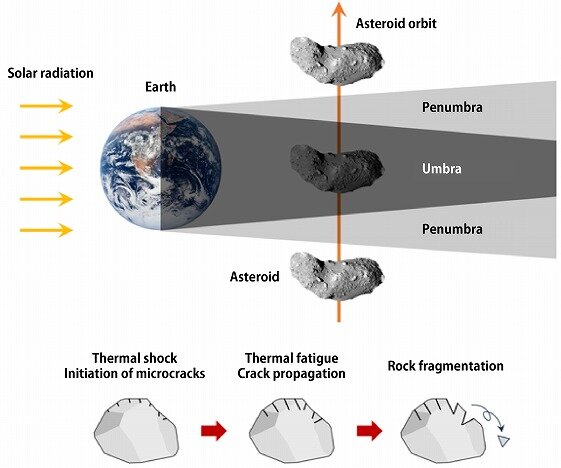
Schematic illustration of surface rejuvenation of near-Earth asteroids caused by planetary shadows
<Paper Information>
Title:Surface rejuvenation of stony near-Earth asteroids by planetary shadows
Authors: Kohei Kitazato, Sho Sakurai, Ryuki Hyodo & Naru Hirata
Name of Journal:Nature Geoscience
DOI:10.1038/s41561-025-01907-w
URL:https://www.nature.com/articles/s41561-025-01907-w
SharedIt Link:(Full text (including figures and illustrations) available) https://rdcu.be/eZbS6
<Terminology>
(Note 1) Near-Earth asteroids
Asteroids that orbit the Sun inside the orbit of Mars and have trajectories that approach Earth's orbit. Because they have the potential to collide with Earth, they are continuously monitored under international cooperation by space agencies such as NASA, ESA, and JAXA.
(Note 2) Thermal shock
A phenomenon in which abrupt heating or cooling generates intense thermal stress within a material.
(Note 3) Thermal fatigue
A phenomenon in which repeated cycles of heating and cooling induce cyclic thermal stress within a material.
(Note 4) Asteroid explorer Hayabusa2
After returning a capsule containing samples from asteroid Ryugu to Earth in 2020, Hayabusa2 has continued the exploration of additional asteroids as part of its extended mission. On July 5, 2026, it is scheduled to conduct a flyby observation of asteroid Torifune at a relative velocity of approximately 5 km/s.
https://www.isas.jaxa.jp/en/topics/004151.html