University of Aizu Department of Computer Science and Engineering
Maxim Ryzhii
Academic homepage

Maxim Ryzhii

Senior Associate Professor

Mathematical and computational modeling of cardiac electrical activity, alongside research in graphene nanoelectronics and terahertz devices.

About

I am a Senior Associate Professor in the Department of Computer Science and Engineering at the University of Aizu, Japan.

My current primary research focus is computational cardiac electrophysiology. I develop and investigate mathematical models of cardiac electrical activity, including pacemaking, atrioventricular conduction, ECG signals, and arrhythmias. These models provide a way to explore normal and abnormal cardiac rhythms through computational experiments.

A second research direction concerns the physics and computer modeling of graphene-based nanoelectronic devices, including plasmonic effects and terahertz radiation detection.

Official University of Aizu faculty profile

Research

My research applies mathematical analysis and computer simulation to complex physical and biological systems.

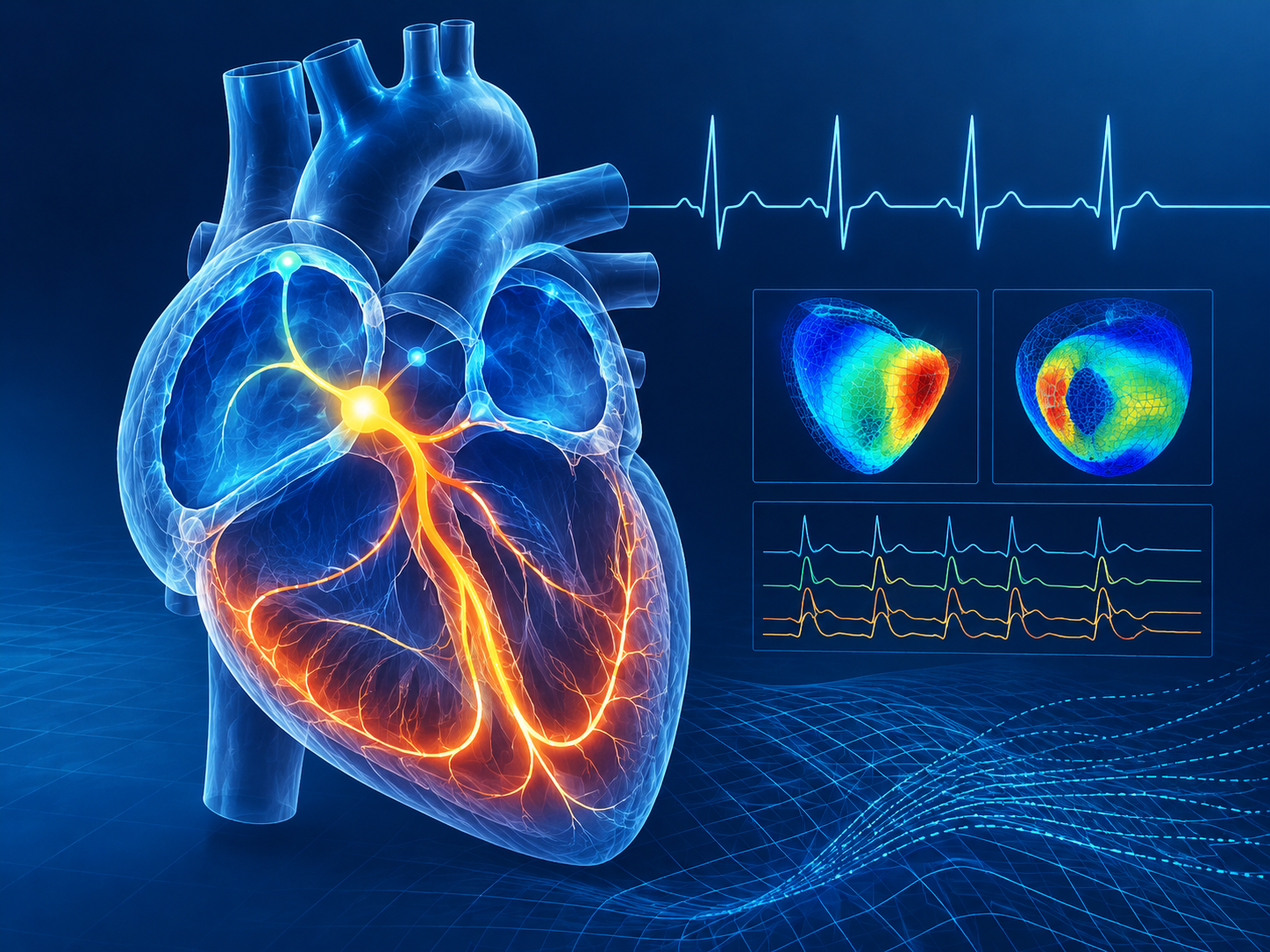
Scientific visualization of a heart, 
electrical activation pathways, ECG traces, and cardiac simulation maps
01 / PRIMARY RESEARCH FOCUS

Cardiac electrophysiology

Mathematical models of cardiac pacemaking and conduction, atrioventricular nodal pathways, ECG generation, and nonlinear dynamics associated with arrhythmias. Current interests include the behavior of the atrio-ventricular (AV) node and the mechanisms underlying normal and abnormal cardiac rhythms.

AV node ECG Arrhythmias Nonlinear dynamics
Scientific visualization of graphene atomic lattices, 
a nanoelectronic device, and terahertz plasmonic waves
02 / NANO-ELECTRONICS

Graphene and terahertz devices

Theoretical and computational studies of graphene-based electronic devices, plasmonic phenomena, terahertz radiation detection, and optoelectronic device characteristics.

GraphenePlasmonics TerahertzDevice physics

Research methods

Selected publications

Selected publications. Follow the publication links for full bibliographic information.

Threshold-Oscillator-Based Binary Computing Using Cell Models

M. Ryzhii and E. Ryzhii · Proc. of 7th Int. Conf. on Computational Vision and Bio Inspired Computing (ICCVBIC 2026) · 2026

Read article / DOI

Assessment of atrioventricular nodal reentrant tachycardia inducibility with alternative pacing methods: Computer simulation

M. Ryzhii and E. Ryzhii · Biomedical Signal Processing and Control · 2026 · 114:109384

Read article / DOI

Atrioventricular nodal reentrant tachycardia onset, sustainability, and spontaneous termination in rabbit atrioventricular node model with autonomic nervous system control

M. Ryzhii and E. Ryzhii · Frontiers in Physiology · 2024 · 15:1529426

Read article / DOI

Temperature dependence of hot-electron graphene FET bolometric detectors response to modulated terahertz radiation

M. Ryzhii, V. Ryzhii, C. Tang, T. Otsuji, V. Mitin, and M.S. Shur · Int. J. High Speed Electron. Syst · 2024 · 33(4):2440024

Read article / DOI

A compact multi-functional model of the rabbit atrioventricular node with dual pathways

M. Ryzhii and E. Ryzhii · Frontiers in Physiology · 2023 · 14:1126648

Read article / DOI

Pacemaking function of two simplified cell models

M. Ryzhii and E. Ryzhii · PLOS ONE · 2022 · 17(4):e0257935

Read article / DOI

Cardiac conduction model for generating 12 lead ECG signals with realistic heart rate dynamics

M.A. Quiroz-Juárez, O. Jiménez-Ramírez, R. Vázquez-Medina, E. Ryzhii, M. Ryzhii, and J.L. Aragón · IEEE Transactions on Nanobioscience · 2018 · 17:525–532

Read article / DOI

A heterogeneous coupled oscillator model for simulation of ECG signals

E. Ryzhii and M. Ryzhii · Computer Methods and Programs in Biomedicine · 2014 · 117:40–49

Read article / DOI

Coulomb drag and plasmonic effects in graphene field-effect transistors enable resonant terahertz detection

M. Ryzhii, V. Ryzhii, T. Otsuji, V. Mitin, and M. S. Shur · Applied Physics Letters · 2022 · 120:111102

Read article / DOI

Fundamental and Applied Problems in Terahertz-Related Devices and Technologies

T. Otsuji, W. Knap, M. Ryzhii, and M.S. Shur (Editors) · World Scientific · 2025

Amazon

Physics and Modeling of Tera- and Nano-Devices

M. Ryzhii and V. Ryzhii (Editors) · World Scientific · 2008

Amazon

Search for additional publications  ·  Scopus  ·  ResearchGate  ·  J-GLOBAL researcher record  ·  KAKEN projects

Scientific societies

Membership in scientific societies

  • American Physical Society, life-long member
  • IEEE, Senior member (Electron Device Society, Engineering in Medicine and Biology Society)
  • Japanese Circulation Society
  • Associate Editor for Scientific Reports journal (Nature publishing)

Teaching

Undergraduate and graduate teaching at the University of Aizu.

Undergraduate courses

  • Electromagnetism NS02 — lectures
  • Electromagnetism NS02 — exercises
  • Semiconductor Devices NS04
  • Thermodynamics and Statistical Mechanics NS05

Graduate courses

  • Advanced Devices for Computer and Communication Systems SYA06
  • Modeling of Advanced Semiconductor Devices SYA07

Academic background

2019–present Senior Associate Professor, University of Aizu
2003 Assistant/Associate Professor, University of Aizu
2001 Doctor of Engineering, Tokyo Institute of Technology
1998 Visiting Researcher, Chalmers University of Technology, Sweden (March–September)
1993 Research Associate, University of Aizu
1992 Master of Science, Moscow Institute of Physics and Technology

Contact

For academic inquiries, research discussions, and student project opportunities, please use the university contact details.

AddressDepartment of Computer Science and Engineering
University of Aizu
Aizu-Wakamatsu 965-8580, Fukushima, Japan
Office 225 C, Research Quadrangle

Official faculty profile